Hindu Marriage Biodata Format PDF: A Blessed Beginning
In a Hindu family, a match often begins long before the first meeting. It begins with a page: a blessing at the top, a family's name, a few lines about who you are and where you come from. That page deserves care.
Create your Hindu marriage biodata PDF in about 2 minutes, with the details elders look for already in place. No login. Nothing uploaded. Your family's story stays with you.
Fill in Your Hindu Biodata Details
WHAT A HINDU MARRIAGE BIODATA CARRIES
A good Hindu biodata is read in a familiar order. Here is how to arrange yours.
A blessing at the top
“ॐ गणेशाय नमः”, “Shree Ganeshaya Namaha”, or the deity your family prays to.
Personal details
Name, date, time and place of birth, height, education and occupation.
Community details
Religion, caste and gotra.
Horoscope details
Rasi, Nakshatram, Lagnam and Manglik status.
Family background
Parents' names and occupations, siblings, and grandparents if you wish.
Contact details
Two family numbers, so no call is missed.
A clear photograph
If you would like to include one.
BUILT FOR HINDU FAMILIES
Customized features crafted thoughtfully around Hindu marriage traditions and astrological matching.
Horoscope fields, ready
Rasi, Nakshatram, Lagnam, Gotra and Manglik are already in the form. Nothing to line up by hand.
Your own blessing
Type your deity's name in your own language as the heading.
Traditional borders and clean modern designs
Choose the one that feels like your home.
Every field is yours to shape
Add, remove or rename anything to suit your family's customs.
Hindu Marriage Biodata Designs
From auspicious golden motifs to minimalist contemporary frames.
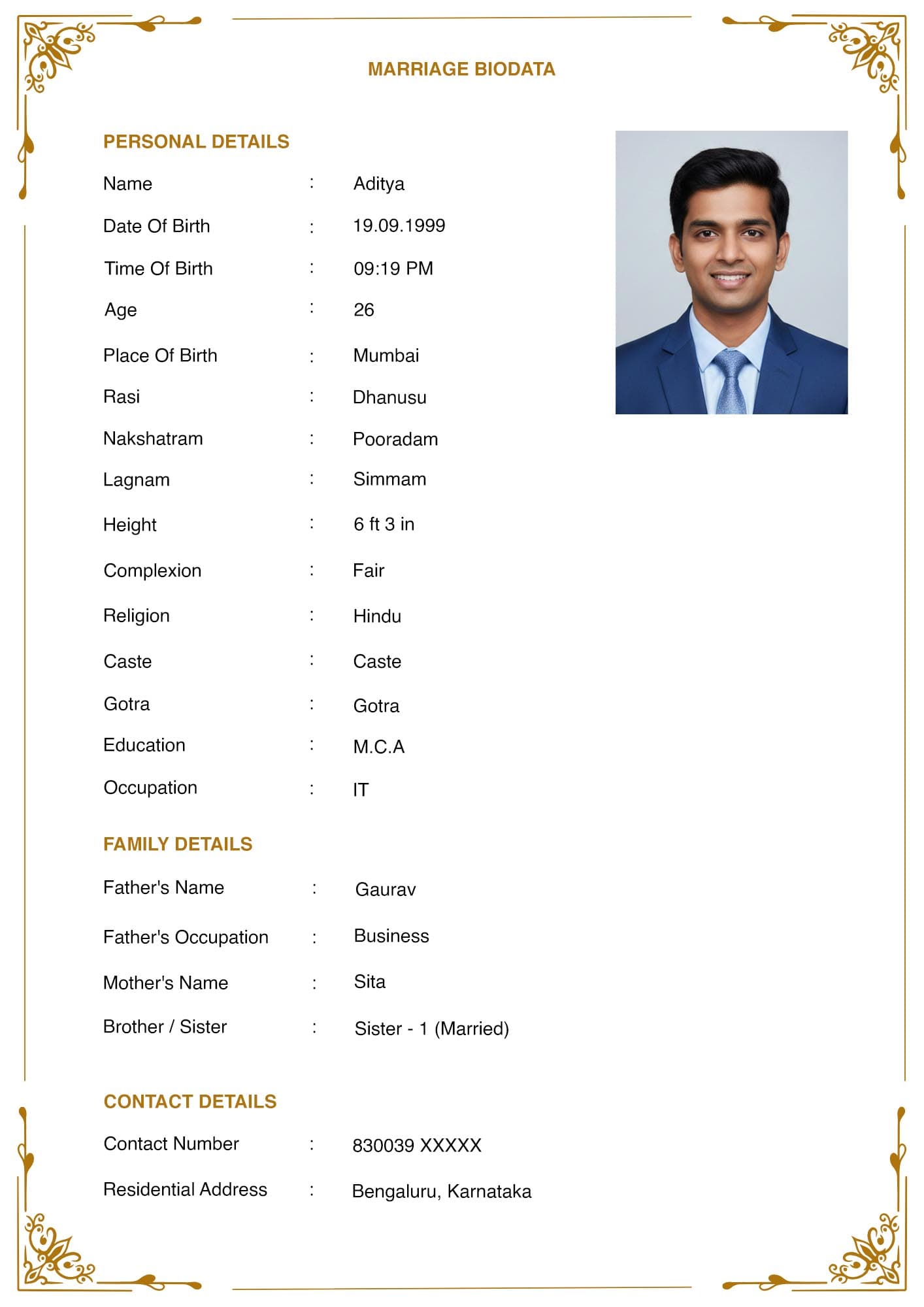
Traditional Golden Floral
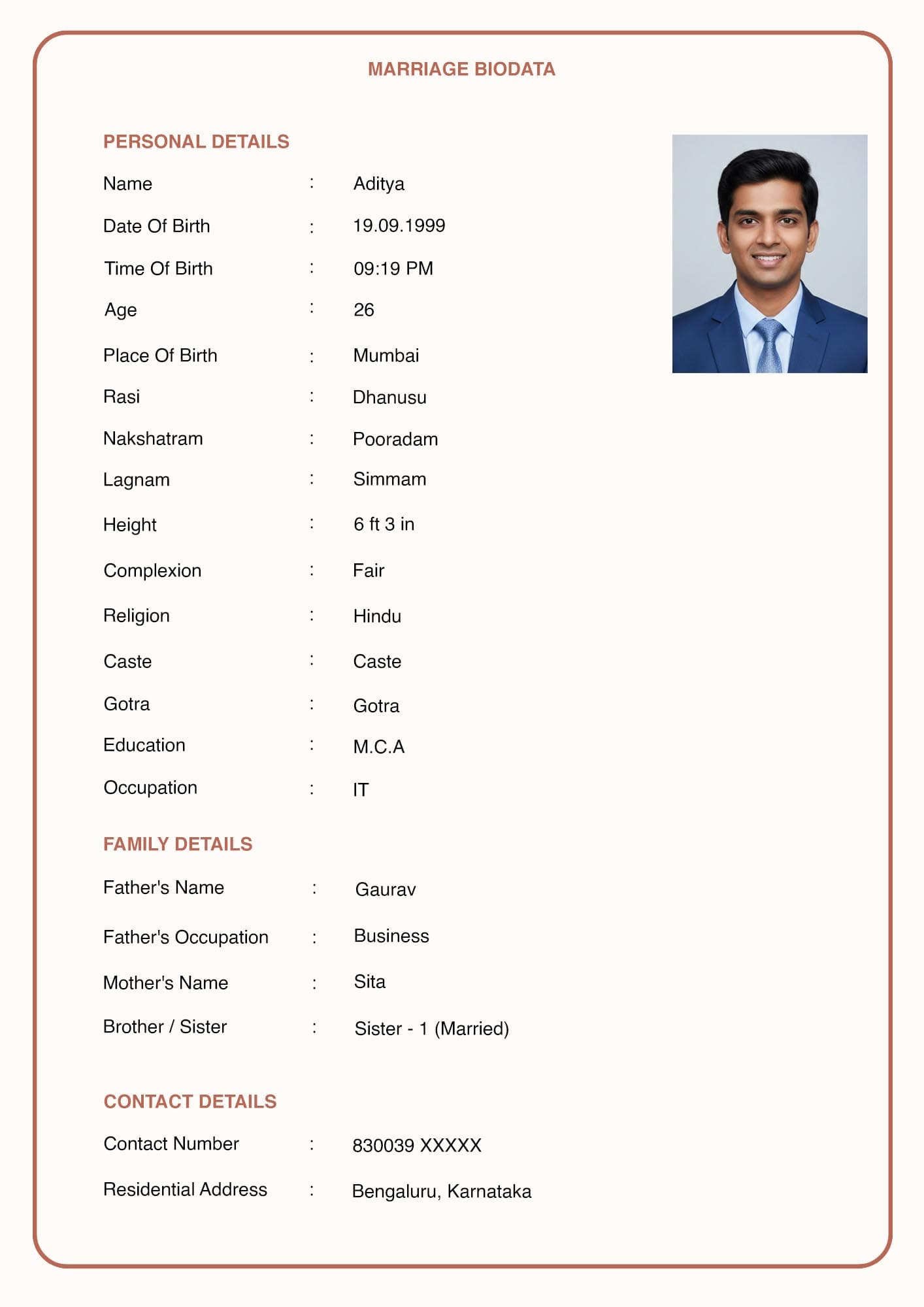
Terracotta Minimalist
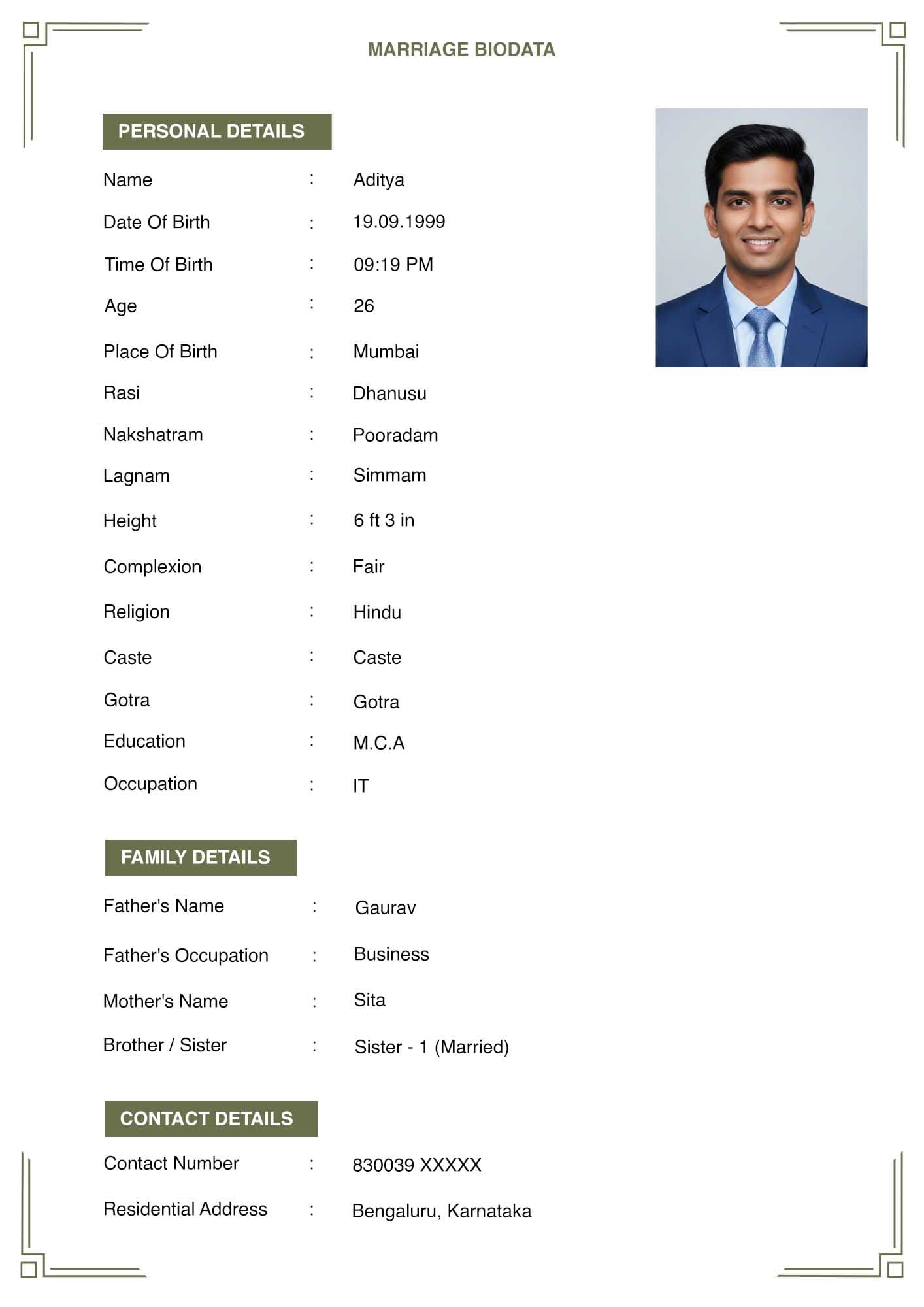
Classic Olive Green
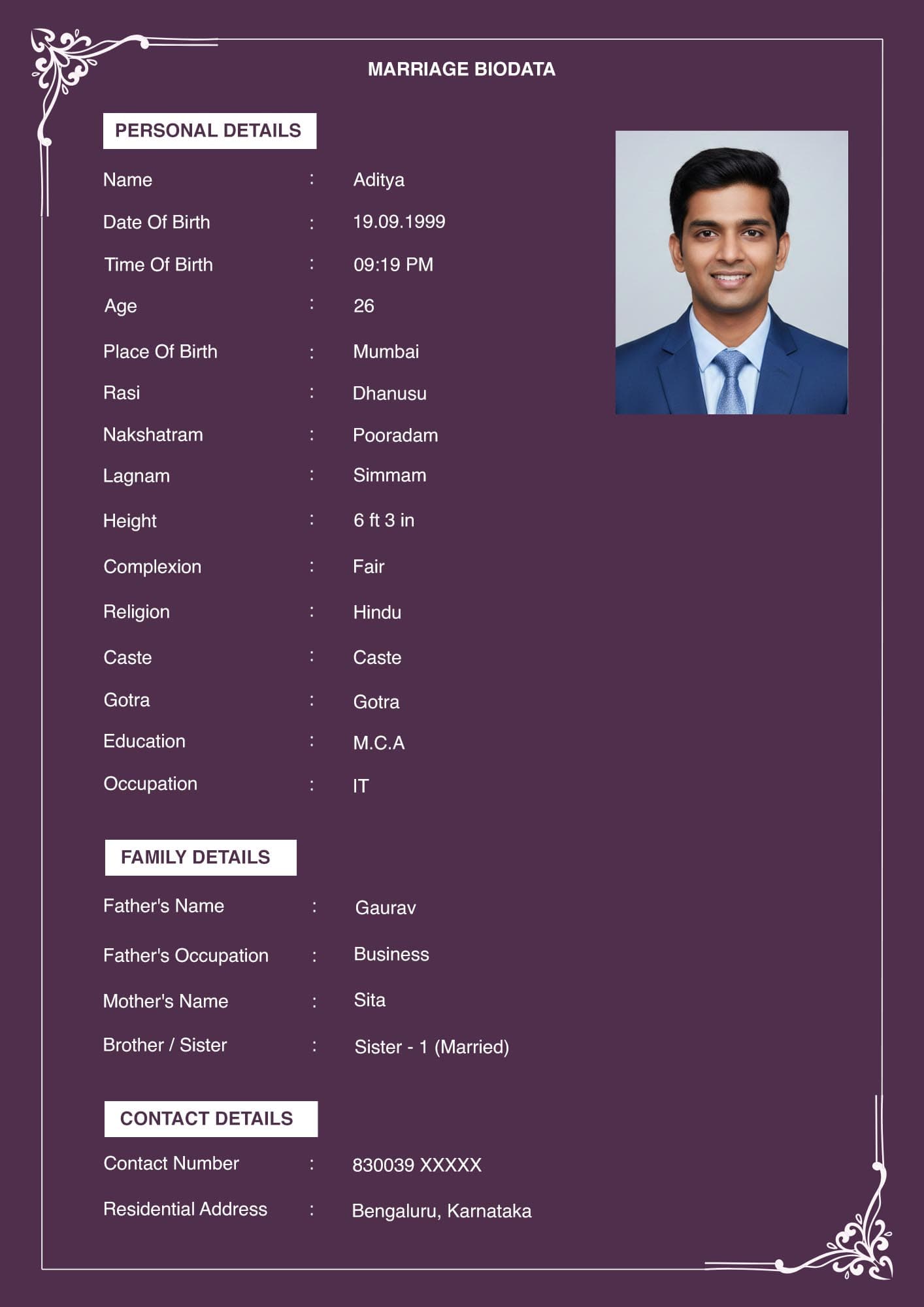
Royal Velvet Heritage
HINDU MARRIAGE BIODATA FORMAT IN HINDI PDF (हिंदू विवाह बायोडाटा)
Some elders are happiest reading in Hindi. Switch the language once and your whole biodata appears in Hindi, with clean fonts and no broken letters. You can also create it in Marathi, Tamil, Telugu, Kannada, Gujarati, Bengali or English.
THREE THINGS THAT MAKE A HINDU BIODATA STAND OUT
Small details that make a lasting, reassuring impression on prospective families.
Get the birth details exactly right
Time and place matter when horoscopes are matched. Check them with your parents before you download.
Use a face-forward photograph
Good light, head and shoulders, a natural smile.
Keep it to one page
Elders prefer a clear, well-spaced page to a crowded one.
HOW IT WORKS
Create and download a clean, print-ready PDF in about 2 minutes.
Fill in your details
The Hindu fields are already there.
Preview it on all 50 designs
Edit anything that needs fixing.
Download a crisp A4 PDF
Share it on WhatsApp, or print it.
FAQ
QWhat is the Hindu marriage biodata format?
It begins with a deity's name, then personal details, horoscope details (Rasi, Nakshatram, Lagnam, Manglik), gotra, family background and contact details. You can rearrange any part to suit your family.
QCan I download a Hindu marriage biodata format in PDF for free?
You can create it and preview it on all 50 designs for free. Free designs download at no charge. Premium designs cost ₹99, one time, with no watermark and no hidden charges.
QCan I make a Hindu biodata for both a boy and a girl?
Yes. The same form works for both. See our dedicated pages for the girl's format and the boy's format.
QCan I get it in Hindi?
Yes. Choose Hindi from the language menu and download your Hindu marriage biodata in Hindi PDF.
QCan I download it in Word format?
We provide PDF, because it looks the same on every phone and printer, while Word files often break layouts and regional fonts. You can edit every detail before you download.
QIs my information private?
Yes. Your biodata is created on your own device. We don't store your details or photo, and your data disappears after you download.