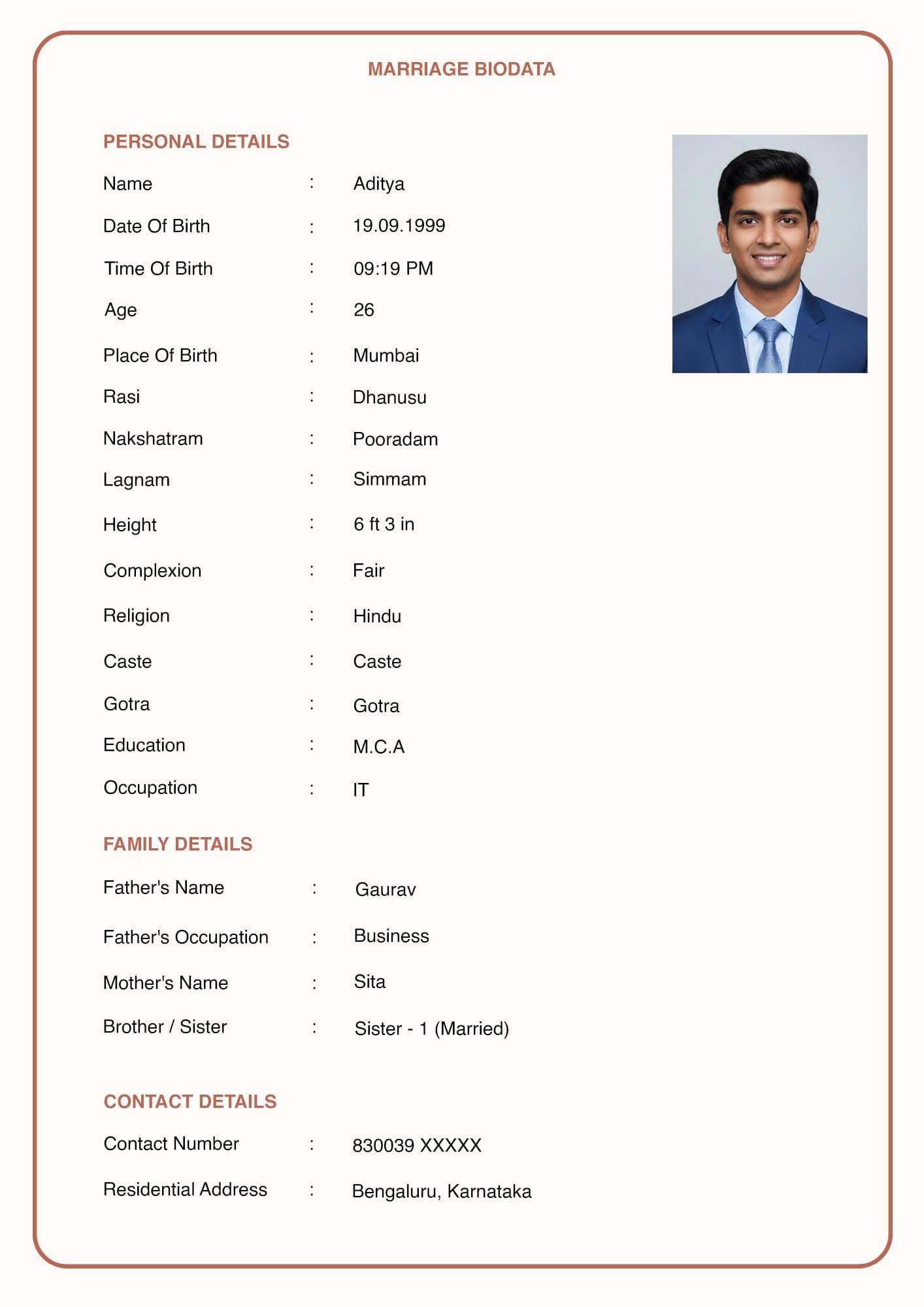
A lot of people open their resume, delete the work experience, add their father's name, and call it a biodata. The result is a document that reads like a job application to a family that is not hiring anyone.
The two formats look similar. They do opposite jobs.
Quick Answer A resume argues that you are the best candidate. A marriage biodata introduces you and your family so another family can decide whether to arrange a first conversation. A resume is about achievement and is written by you, for you. A biodata is about background and is read by parents. Copying one into the other is the most common formatting mistake in this category.
The Core Difference in One Line
A resume persuades. A biodata introduces.
That sounds like a small distinction. It changes almost every field on the page.
A resume is competitive by design. You are being compared against other applicants, so you lead with accomplishments, quantify results, and leave out anything that weakens the case. Nobody lists their family on a resume, because it is irrelevant to the decision.
A biodata is not competitive in that way. The reader is not ranking you against a shortlist. They are checking whether the basics fit, and the basics include your family, your community, and where you are from. Those are the fields a resume deliberately omits.
Field by Field
| Element | Job resume | Marriage biodata |
|---|---|---|
| Purpose | Win an interview | Start a family conversation |
| Read by | Recruiter or hiring manager | Parents, then the candidate |
| Length | One to two pages | One page, almost always |
| Family details | Never included | Central, roughly a third of the page |
| Date of birth | Usually omitted | Required, and often with birth time |
| Photo | Usually omitted in India for jobs | Expected |
| Achievements | The main content | One line, if that |
| Work history | Full chronology | Current role and sector only |
| Community and native place | Never | Commonly expected |
| Salary | Never stated | Sometimes indicated as a range |
| Tone | Assertive | Plain and factual |
The row that surprises people most is work history. On a resume, six years across three companies is a story you tell carefully. On a biodata it is one line: your current role and sector. The family reading it wants to know what you do, not how your career progressed.
For the complete field list, see [INTERNAL-LINK: complete field checklist → spoke A1].
What Happens When You Copy Your Resume
Three predictable failures.
- It runs long. Resume habits produce bullet points under every role, a skills section, and a certifications list. The biodata reaches two pages before the family details even appear. Nobody reads the second page.
- It sounds like a pitch. Resume language is achievement language. "Spearheaded a cross-functional initiative delivering 30 percent efficiency gains" is fine in a job application. On a biodata it reads as boasting to a family that simply wanted to know what you do for a living.
- It omits what actually matters. A resume-derived biodata usually has no father's occupation, no native place, no sibling detail. Those are the first things the other family looks for. Their absence generates a phone call asking for exactly the information you left out.
What Carries Over
Not everything transfers badly. Three resume habits are genuinely useful here.
- Brevity. The discipline of fitting on one page is the right instinct. Apply it harder.
- Specificity. "Software engineer, IT services company" beats "working in a reputed MNC" for the same reason a resume avoids vague phrasing. It tells the reader something.
- Proofreading. People check their resume three times and their biodata once. The biodata gets forwarded to more people and lasts longer.
The Naming Confusion
You will see several terms used for the same document. They mean effectively the same thing in Indian usage.
- Marriage biodata is the most common term nationally.
- Matrimonial biodata appears more often on matrimonial websites.
- Shaadi biodata or vivah biodata in Hindi-speaking regions.
- Jathagam biodata in Tamil usage, though strictly the jathagam is the horoscope section within it, not the whole document.
None of these describes a different format. The four-block structure is the same. If a template site presents "matrimonial resume" as a distinct product, it is a naming choice, not a different document.
Frequently Asked Questions
Is a marriage biodata the same as a CV?
No. A CV is an academic and professional record, often several pages. A marriage biodata is a one-page family introduction. The only overlap is your education and current role, each reduced to a line.
Can I use my LinkedIn profile as a biodata?
No. A LinkedIn profile has no family details, no community fields, and no birth date. Those are the sections families read first.
Should I mention my achievements at all?
One line, if something is genuinely notable and easy to understand. A national-level sports achievement or a well-known qualification is worth a mention. A list of internal awards is not.
Why do biodatas include family details when resumes do not?
Because an arranged introduction is between families, not only between two individuals. The other side is deciding whether the households are compatible, which is why father's occupation and native place carry real weight.
In Short
- A resume persuades. A biodata introduces. Every difference follows from that.
- Family details are roughly a third of a biodata and absent from a resume.
- Work history compresses to one line.
- Copying a resume produces a long, boastful document missing the fields families actually read.
If you have been working from a resume, start again from the four-block structure in the [INTERNAL-LINK: marriage biodata format guide → pillar page]. Then use [INTERNAL-LINK: one-page biodata format → spoke A3] to get it onto a single sheet.