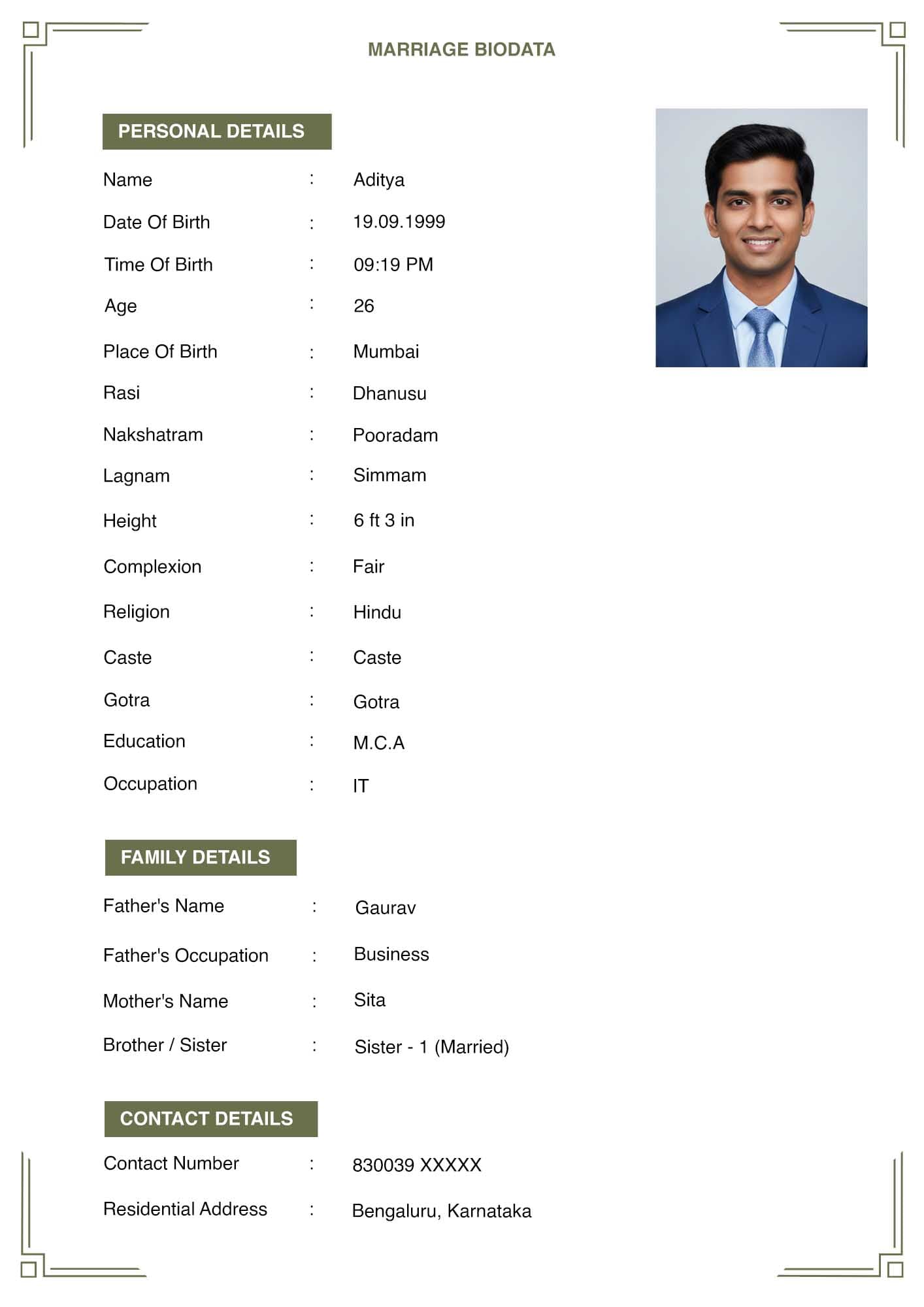
Marriage Biodata PDF: Format, Free Sample, and How to Make One
Your marriage biodata will be read by people you never meet. It gets printed, photographed, and forwarded through family WhatsApp groups for months. That is the real design brief, and it changes how you fill in every line.
Most people making one have never seen a correct example. They copy whatever the first template gives them and add every detail they can think of. The result runs to two pages and says very little.
This page gives you the standard format, two complete filled samples you can copy, and a clear list of what to leave out.
Quick Answer A marriage biodata is a one-page introduction document with four blocks: personal details, family details, education and career, and contact plus partner preferences. Keep it to one page. Use a recent, plain photo. Leave out your Aadhaar number, PAN, and full residential address, because the file will be forwarded to people you cannot see. Complete filled samples for a girl and a boy are below.
What Is a Marriage Biodata?
A marriage biodata is a one-page introduction document that a family circulates when looking for a match. It is not a job resume. Nobody is scoring your achievements. The reader is deciding whether to arrange a first conversation.
That distinction matters because it changes what belongs on the page. A resume argues for you. A biodata introduces you and your family, plainly, so the other side can decide whether the basics fit.
The document still carries weight because family-arranged introductions remain the common path. The India Human Development Survey II surveyed households across 384 districts. It found that 73 percent of marriages were arranged by parents (India Human Development Survey, survey conducted 2011-12). That survey round is now more than a decade old. It remains the most recent nationally representative measure of marriage arrangement that we could verify.
Read alongside that, your biodata is often the first and only thing another family knows about you before deciding whether to talk.
For the full comparison with a job resume, see [INTERNAL-LINK: how a biodata differs from a resume → spoke A2, Biodata vs Resume].
The Standard Marriage Biodata Format
Every workable marriage biodata uses the same four blocks, in the same order. Communities change what goes inside the first block. The structure itself does not change.
Here is what belongs in each field, and the mistake that shows up most often.
| Field | Required? | What to write | Common mistake |
|---|---|---|---|
| Full name | Yes | Name as it appears on official documents | Adding nicknames or titles |
| Date of birth | Yes | Date, and place if the family follows horoscope matching | Writing only the age, which dates the document |
| Time and place of birth | Community-dependent | Exact time, city or town | Approximating the time, which makes the entry useless |
| Height | Yes | In feet and inches, or centimetres | Rounding up |
| Education | Yes | Highest qualification, then institution | Listing every certificate since school |
| Occupation | Yes | Role and sector, for example "Software engineer, IT services" | Naming the employer when privacy matters |
| Community | Convention-dependent | As your family states it | Leaving it blank when the family expects it |
| Gotra, rashi, nakshatra | Hindu families, commonly | Exactly as your family or priest states it | Guessing, or writing an approximation |
| Father's name and occupation | Yes | Name, then occupation or "Retired" | Adding designation history |
| Mother's name and occupation | Yes | Name, then occupation or "Homemaker" | Omitting the mother entirely |
| Siblings | Yes | Number, and marital status if relevant | Full details for every sibling |
| Native place | Usually | Town or district | Full ancestral address |
| Contact | Yes | One person, one number, city and area | Full residential address |
| Partner expectations | Optional | Two or three genuine criteria | A long list of demands |
Two rules govern the whole table. Write what you can verify, and stop when the reader has enough to decide on a conversation.
For the exhaustive version of this checklist, see [INTERNAL-LINK: complete field checklist → spoke A1, What to Include in a Marriage Biodata].
A Complete Filled Sample (Girl)
This is a full, realistic biodata. Copy the structure, not the details.
Marriage Biodata
| Name | Priya Ramesh Kulkarni |
| Date of birth | 14 March 1998 |
| Time and place of birth | 6:20 AM, Pune, Maharashtra |
| Height | 5 ft 4 in |
| Community | Maharashtrian Brahmin (Deshastha) |
| Gotra | Kashyap |
| Rashi / Nakshatra | Vrishabha / Rohini |
| Education | B.E. Computer Science, Savitribai Phule Pune University |
| Occupation | Software engineer, IT services company, Pune |
| Languages | Marathi, Hindi, English |
Family Details
| Father | Ramesh Kulkarni, retired bank manager |
| Mother | Sunita Kulkarni, school teacher |
| Brother | One elder brother, married, works in Bengaluru |
| Native place | Kolhapur, Maharashtra |
| Family type | Nuclear |
Contact and Expectations
| Contact person | Ramesh Kulkarni (father) |
| Phone | +91 98XXX XXXXX |
| Location | Kothrud, Pune |
| Looking for | A graduate from a similar background, settled in Pune or open to relocating, comfortable with a working partner |
Why it is written that way
- The name matches her documents. No nickname. The same name will appear on every later paper.
- Date of birth, not age. An age becomes wrong the moment the file is forwarded a year later.
- Birth time is exact. If a family does horoscope matching, an approximate time is worse than none, because it produces a confidently wrong result.
- Height is stated honestly. It gets checked at the first meeting.
- Occupation names the role and sector, not the employer. She keeps her privacy without hiding what she does.
- The mother's occupation is listed. Many biodatas omit it. Leaving it out reads as an oversight.
- Sibling detail is one line. The reader needs the shape of the family, not a second biodata.
- One contact person only. Her father fields the calls, which is what the family wanted.
- Expectations are three real criteria. Not a list of twelve.
- No complexion, no weight, no salary figure. More on that below.
For a version aimed specifically at this case, see [INTERNAL-LINK: marriage biodata format for a girl → spoke B1].
A Complete Filled Sample (Boy)
A different community, a different family shape, and South Indian horoscope fields.
Marriage Biodata
| Name | Arun Krishnan |
| Date of birth | 2 September 1994 |
| Time and place of birth | 11:45 PM, Madurai, Tamil Nadu |
| Height | 5 ft 9 in |
| Community | Tamil Iyer |
| Star (Natchathiram) | Pooram |
| Raasi | Simmam |
| Lagnam | Mithunam |
| Education | M.E. Mechanical Engineering, Anna University |
| Occupation | Senior design engineer, automotive manufacturing, Chennai |
| Languages | Tamil, English, basic Hindi |
Family Details
| Father | Krishnan Subramanian, late |
| Mother | Lakshmi Krishnan, retired government employee |
| Sisters | Two younger sisters, both students |
| Native place | Madurai, Tamil Nadu |
| Family type | Joint family, lives with mother |
Contact and Expectations
| Contact person | Arun Krishnan |
| Phone | +91 90XXX XXXXX |
| Location | Adyar, Chennai |
| Looking for | A graduate, working or open to working, willing to settle in Chennai |
Why it is written that way
- The Tamil horoscope fields replace the North Indian ones. Natchathiram, raasi and lagnam sit where gotra, rashi and nakshatra would appear in a Marathi biodata. The block does the same job with different field names.
- A deceased parent is stated plainly. "Late" is the convention. It is not something to work around.
- He is his own contact. Some candidates handle their own introductions. That is normal and should be stated clearly, so the other family knows who will answer.
- Unmarried sisters are mentioned briefly. Families often want to know. One line is enough.
- "Joint family, lives with mother" is honest. Living arrangements come up eventually. Stating them early saves a wasted conversation.
- Expectations are short and specific. Three lines that actually filter.
For the boy-specific version, see [INTERNAL-LINK: marriage biodata format for a boy → spoke B2].
Format Variations by Community
The four blocks stay fixed. What changes is the personal-details block, and mainly the horoscope and community fields inside it.
| Community | Fields commonly added | Notes |
|---|---|---|
| Hindu (North and West) | Gotra, rashi, nakshatra, manglik status | Gotra is asked for early, because marriage within the same gotra is traditionally avoided |
| Hindu (South) | Natchathiram or star, raasi, lagnam, kula deivam | Field names are usually written in the regional language even on an English biodata |
| Muslim | Sect, maslak where relevant, mahr expectations in some families | Horoscope fields do not apply |
| Sikh | Gotra in some families, amritdhari status where relevant | Many families keep the personal block short |
| Christian | Denomination, parish | Horoscope fields do not apply |
| Jain | Sect (Digambar or Shwetambar), gotra in some families | Dietary detail is often included and genuinely used |
Two things are worth saying plainly. First, write the horoscope fields exactly as your family or priest states them. Guessing a nakshatra is worse than leaving it blank, because the other family will act on what you wrote.
Second, this page explains what these fields are and how to enter them. It does not interpret them. Compatibility matching is a matter for your family and their astrologer, not for a format guide.
The Photo
One recent photo, plain background, good light, dressed as you would be for a first meeting. That is the whole rule.
A few specifics that actually matter:
- Recent means within the last year. A photo from five years ago creates an awkward first meeting.
- Plain background. A wall works. A crowded family function does not.
- Face clearly visible. No sunglasses, no heavy filters, no group crop where your arm is draped over someone who has been cut out.
- Portrait orientation. A landscape photo either gets squashed or cropped badly when placed on an A4 page.
- Send the original file, not a WhatsApp forward. Forwarded images are compressed each time. A photo that has been through three forwards prints as a blur.
That last point catches people out constantly. The photo looked fine on a phone, then the printed copy handed around at a family gathering looked poor.
For sizing and pose detail, see [INTERNAL-LINK: biodata photo size and pose → spoke C3].
What to Leave Out
This is the section most format guides skip, and it is the one that costs people the most.
Your biodata is forwarded. It moves from a WhatsApp chat into a group, then into another family's group, then to a consultant who keeps a folder of them. You cannot recall it. Write it knowing that.
Never include:
- Aadhaar number. There is no stage of a marriage introduction that needs it.
- PAN number. Same.
- Bank or financial account details. Same.
- Your full residential address. Write the area and the city. "Kothrud, Pune" tells the other family what they actually want to know, which is where you live and whether it is near.
- Your exact salary figure. If your family wants income indicated, a range or "as per industry standard" is the convention. A precise figure invites a negotiation you did not intend to open.
- Your employer's name, if privacy matters to you. "Software engineer, IT services company" is enough. People working in small towns or in visible roles have good reason to leave the name out.
- Social media handles. Sharing those is a decision for later, once a conversation has actually started.
On complexion: leave it out. Some biodata guides still coach people on how to describe skin tone politely. The better answer is not to describe it at all. The photo is already on the page. A complexion line adds nothing the reader cannot see, and it carries a judgment nobody needs to invite into their own introduction. Weight belongs in the same category.
One legal detail is worth stating correctly, since the date of birth sits at the top of the page. In India the minimum age of marriage is 21 for men and 18 for women. That comes from the Prohibition of Child Marriage Act, 2006. An amendment bill introduced in December 2021 proposed raising the age for women to 21. It was referred to a parliamentary standing committee and lapsed when the 17th Lok Sabha was dissolved (PRS Legislative Research, retrieved 2026-08-28). The 2006 thresholds still stand.
For the full treatment, see [INTERNAL-LINK: what never to put in a biodata → spoke D2].
How to Get a Print-Ready PDF
Send a PDF. Keep a Word copy for yourself.
The reason is layout. A Word file re-flows depending on the fonts and version installed on the reader's device. Your careful one-page biodata becomes a page and a half on someone else's laptop, with the photo pushed onto the second page. A PDF looks the same everywhere it is opened.
A few output rules:
- A4, one page. This is the standard page size in India and the size every print shop expects.
- Keep the file between roughly 200 KB and 500 KB. It should open quickly on a slow connection and still print the photo cleanly.
- Check the margins before printing. Content running to the edge of the page gets clipped by most printers.
- Print one copy and look at it. Families still hand around paper. What reads well on a phone can look cramped on paper.
If you want the editable version for later updates, keep the Word file yourself and send only the PDF. See [INTERNAL-LINK: Word or PDF → spoke C1] and [INTERNAL-LINK: print-ready A4 biodata → spoke C2].
Once your details are ready, you can [INTERNAL-LINK: create your biodata → product page] and download a print-ready A4 PDF.
Frequently Asked Questions
What is the standard marriage biodata format?
Four blocks in order: personal details with a photo, family details, education and career, and contact plus partner preferences. Community-specific fields such as gotra, rashi, nakshatra, or natchathiram and raasi sit inside the personal-details block.
How many pages should a marriage biodata be?
One page. A second page almost always means unnecessary detail has crept in. If you cannot fit on one page, cut sibling details and shorten the expectations section first.
Should I mention my salary in a marriage biodata?
You do not need to state an exact figure. If your family expects income to be indicated, a range or a phrase such as "as per industry standard" is the usual convention. A precise number invites a negotiation and travels with the document permanently.
Is a photo compulsory in a marriage biodata?
It is not compulsory, but nearly every family expects one, and a biodata without a photo usually prompts a request for one. If you would rather not circulate a photo widely, send the biodata without it and share the photo separately once a conversation has begun.
What should I never include in a marriage biodata?
Aadhaar number, PAN, bank details, and your full residential address. Skip complexion and weight. Consider leaving out your employer's name and exact salary if privacy matters to you.
Can I edit a biodata PDF after downloading it?
Not easily. A PDF is a fixed-layout file, which is exactly why it is the right thing to send. Keep an editable copy in Word or in the tool you built it with. Make changes there, then export a fresh PDF each time your details change.
In Short
- A marriage biodata is a one-page introduction document, not a resume.
- Four blocks, in a fixed order. Only the personal-details block changes between communities.
- Write the horoscope fields exactly as your family states them, or leave them blank.
- Leave out Aadhaar, PAN, full address, complexion, and weight. The file will be forwarded beyond your reach.
- Send a PDF at A4, one page, and print one copy before circulating it.
If your community follows a format not covered here, start with the four blocks above and add the fields your family expects. The structure holds. See [INTERNAL-LINK: common biodata mistakes → spoke D3] for the errors that come up most often.