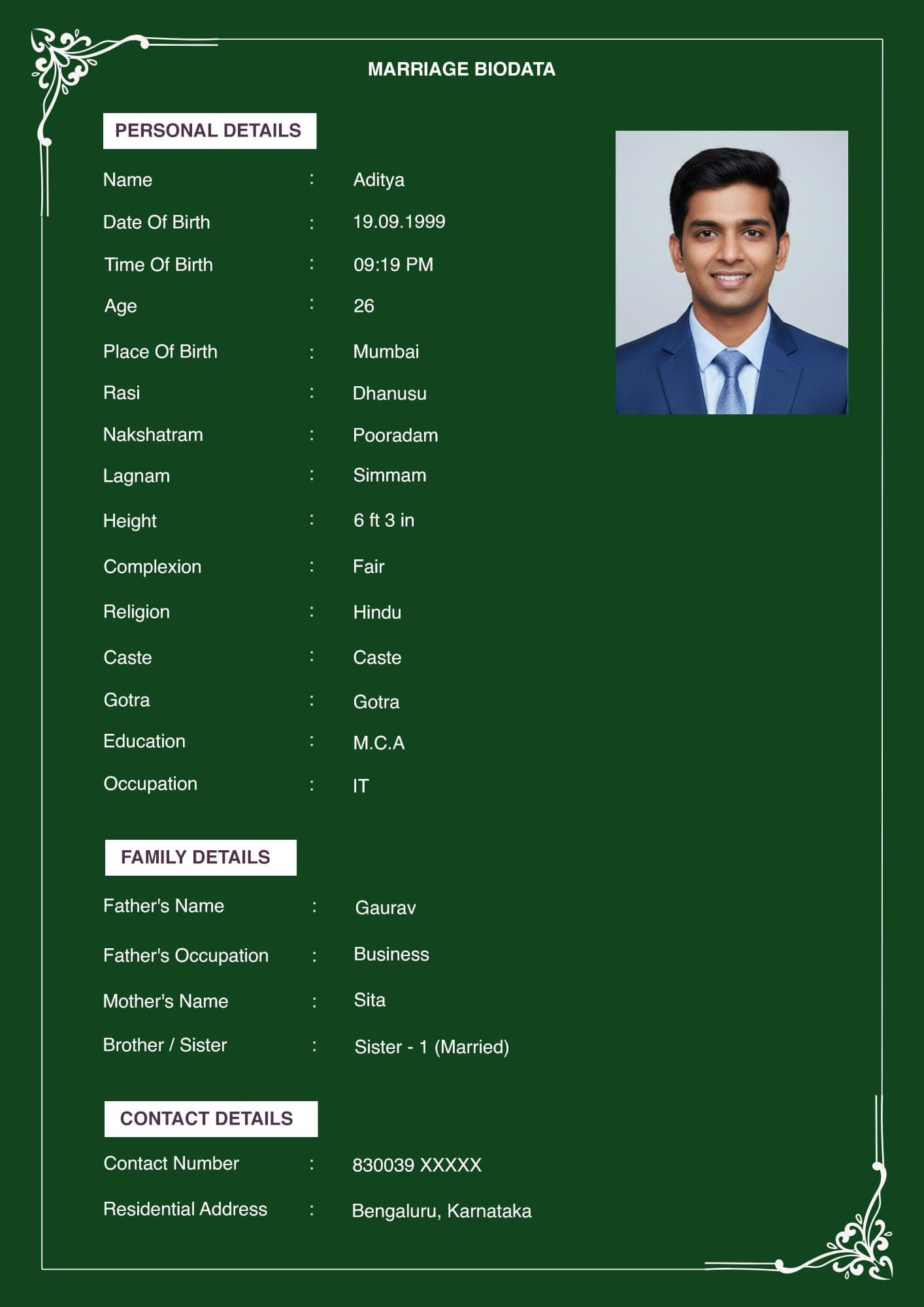
Most biodata templates assume a first marriage. They have no field for marital status, no place to mention children, and no room for the two lines of context that make the document honest.
The fix is small. The format stays the same. Two fields get added, and one gets handled with more care.
Quick Answer A second-marriage biodata uses the same four blocks, plus a marital status field and, where relevant, a line about children. State the status plainly as "Divorced", "Widowed", or "Separated". A one-line factual note on circumstances is enough. Do not explain, defend, or assign blame on the document. Mention children, their ages, and custody, because it will be asked at the first conversation regardless.
Where the Extra Fields Go
Marital status belongs in the personal block, directly after date of birth. Not buried at the bottom, and not left out.
Putting it high is deliberate. Anyone who would not consider a second marriage finds out immediately, and the conversation ends before either family has invested time. That saves everybody, including you.
Children, if any, go at the end of the personal block or at the start of the family block. Either placement is fine as long as it is not hidden.
How to State the Status
Plainly, in one or two words, then a single factual line if context genuinely helps.
- Divorced. "Divorced, 2023. Legally concluded, no dependents." That is enough. You are not required to give reasons on a document that will be forwarded to strangers.
- Widowed. "Widowed, 2022." Nothing more is needed unless you wish to add it.
- Separated but not yet divorced. State it accurately. "Separated since 2024, divorce proceedings ongoing." Families will ask about the legal position, and an unclear answer at this stage causes real problems later.
- Annulled. "Marriage annulled, 2021." Some families treat this differently from a divorce, so the accurate word matters.
What not to write: an explanation of what went wrong, any characterisation of the other person, or a defensive paragraph. It reads badly, and none of it belongs on a sheet that gets photocopied.
Mentioning Children
If you have children, put it on the biodata. Every time.
It will be asked in the first conversation. Leaving it out does not delay the question. It only means the other family learns something significant after they have begun to consider the match. That reads as concealment, even when none was intended.
State three things: how many, their ages, and the custody position.
"One daughter, aged 6, lives with me." That is the whole entry. It is clear, it is factual, and it lets the other family make an informed decision at the right stage.
If children do not live with you, say so in the same plain way. "One son, aged 9, lives with his mother."
A Complete Filled Sample
Marriage Biodata
| Name | Sneha Prakash Nair |
| Date of birth | 11 January 1990 |
| Marital status | Divorced, 2022. Legally concluded. |
| Children | One daughter, aged 7, lives with me |
| Height | 5 ft 4 in |
| Community | Nair |
| Education | MBA Finance, Cochin University |
| Occupation | Finance manager, logistics company, Kochi |
| Languages | Malayalam, English, Hindi |
Family Details
| Father | Prakash Nair, retired bank officer |
| Mother | Geetha Nair, retired teacher |
| Sibling | One younger brother, married, in Dubai |
| Native place | Thrissur, Kerala |
Contact and Expectations
| Contact person | Sneha Nair |
| Phone | +91 95XXX XXXXX |
| Location | Kakkanad, Kochi |
| Looking for | A graduate, open to a second marriage, comfortable with a child in the household |
The expectations line does real work here. "Open to a second marriage, comfortable with a child in the household" filters accurately at the first read. It is far more useful than a general list of preferences.
The Horoscope Question
Some families that follow horoscope matching apply it to second marriages, and some do not. If yours does, include the fields as usual. If the previous marriage involved a horoscope match that the family now views differently, that is a conversation between your family and their astrologer.
This page explains what the fields are and how to enter them. It does not interpret them.
A Note on Tone
The most common mistake in a second-marriage biodata is not a missing field. It is an apologetic tone.
Phrases like "seeking a second chance at happiness" or "unfortunately my first marriage did not work out" appear frequently, and they weaken the document. The reader is not owed an apology. They are being given the facts they need to decide whether to talk.
Write it in the same plain, factual register as any other biodata. Status, children, and the same eleven fields everyone else fills in. The document does its job better that way.
Frequently Asked Questions
Do I have to mention that I am divorced on a biodata?
Yes. It will be established in the first conversation. Stating it plainly at the top saves both families time and avoids the impression that something was withheld.
Should I explain why my first marriage ended?
No. One factual line about the legal status is sufficient. Reasons belong in a conversation between families, not on a document that circulates widely.
Do I need to mention my children?
Yes, including their ages and who they live with. It is one of the first things the other family will ask, and it is central to whether the match works.
Is the format different for a widowed candidate?
No. The same marital status field, stated as "Widowed" with the year. No further explanation is required.
Can a second-marriage biodata still fit on one page?
Usually yes. Two extra lines rarely push it over. If it does run long, cut hobbies and expectations before anything else. See [INTERNAL-LINK: one-page biodata format → spoke A3].
In Short
- Same four blocks, plus marital status and, where relevant, children.
- Put the status high in the personal block, not at the bottom.
- One factual line. No explanations, no blame, no apology.
- Always mention children, their ages, and custody.
For the underlying structure, see the [INTERNAL-LINK: marriage biodata format guide → pillar page], and check [INTERNAL-LINK: what never to put in a biodata → spoke D2] before you circulate it.