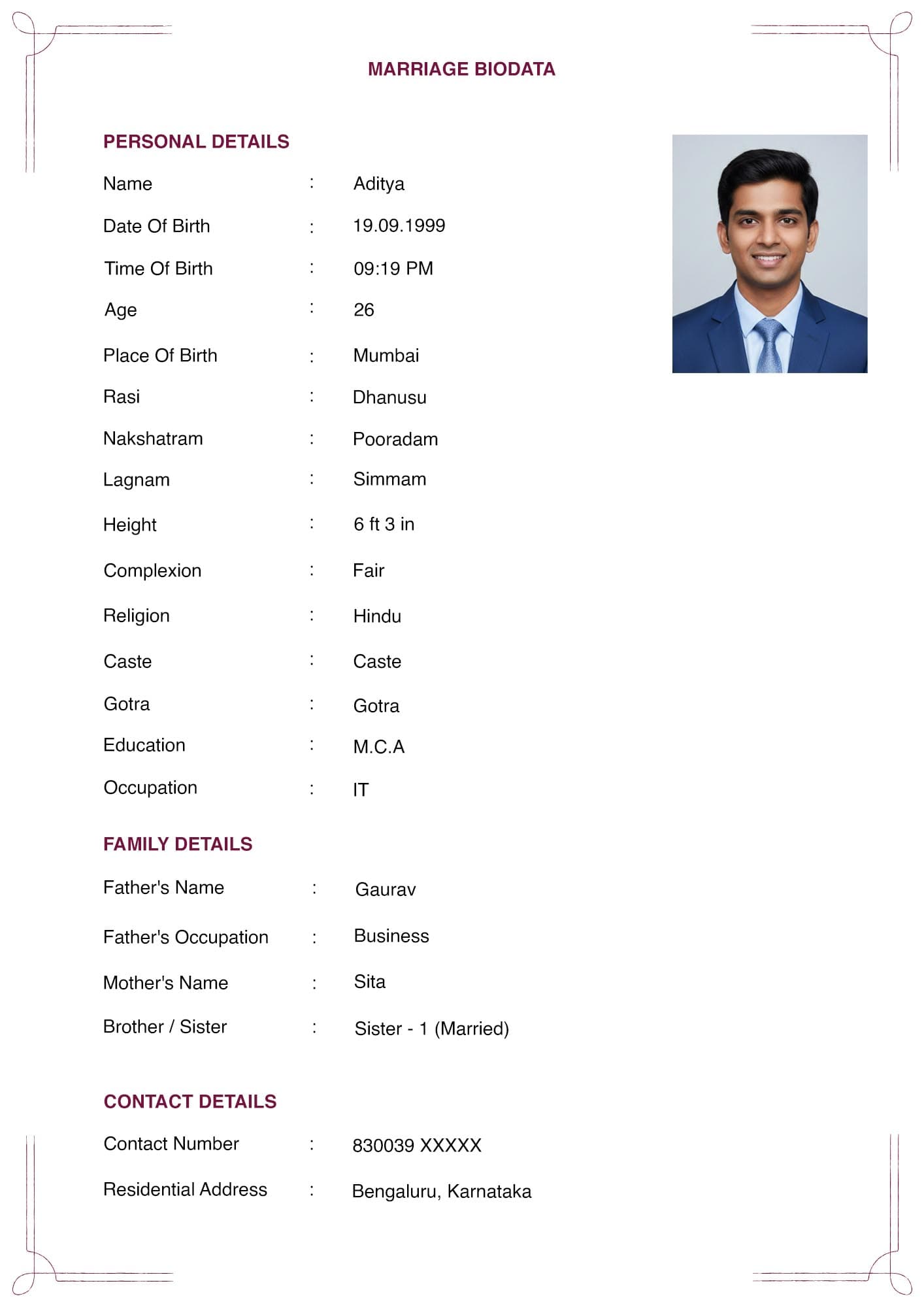
A one-page biodata is not a compromise. It is the format working the way it was meant to.
The document exists to be photocopied, carried to a family meeting, and forwarded on a phone. All three of those work better with one sheet. A second page usually means detail crept in that nobody asked for.
Quick Answer A one-page marriage biodata holds a photo, eleven personal and family fields, and two or three lines of expectations. If your draft runs longer, cut the hobbies list, the achievements, the sibling details beyond one line, and any paragraph describing your personality. A complete one-page sample is below.
What Fits on One Page
An A4 sheet with normal margins holds roughly 22 to 26 lines of biodata content alongside a passport-size photo. That is the real constraint.
Here is how those lines are usually spent:
| Block | Lines | Contents |
|---|---|---|
| Header | 1 to 2 | Title, and name |
| Personal | 8 to 10 | DOB, height, education, occupation, community, horoscope fields |
| Family | 5 to 6 | Father, mother, siblings, native place |
| Contact | 2 to 3 | Contact person, number, city and area |
| Expectations | 2 to 3 | Two or three criteria |
That totals a little over 20 lines. Anything else has to displace something already on the list.
A Complete One-Page Sample
Marriage Biodata
| Name | Neha Sanjay Deshmukh |
| Date of birth | 9 July 2000 |
| Height | 5 ft 3 in |
| Community | Maratha |
| Education | B.Com, Fergusson College, Pune |
| Occupation | Accounts executive, manufacturing firm, Pune |
| Father | Sanjay Deshmukh, agriculture and dairy business |
| Mother | Vaishali Deshmukh, homemaker |
| Siblings | One younger brother, studying engineering |
| Native place | Satara, Maharashtra |
| Contact | Sanjay Deshmukh, +91 98XXX XXXXX, Baner, Pune |
| Looking for | A graduate from a Maratha family, settled in or near Pune |
Twelve lines and a photo. It fits with room to spare, and it answers every question a family asks at the first stage.
Notice what is absent. No hobbies. No personality paragraph. No list of school achievements. No complexion, no weight, no salary figure. None of it was missed.
This sample has no horoscope fields, because this family does not use them. If yours does, add gotra, rashi and nakshatra to the personal block and cut the expectations to two lines.
What to Cut When Your Draft Runs Long
Cut in this order. Each one is safe.
- The hobbies list. "Reading, music, travelling" appears on a large share of biodatas and carries no information. If you keep hobbies at all, keep one specific one.
- Achievements and certifications. School and college awards, internal work awards, short courses. None of it changes a family's decision at this stage.
- Sibling detail beyond one line. Their qualifications, their employers, their spouse's background. One line is the convention.
- The personality paragraph. "I am a family-oriented person with a positive outlook" describes nearly everyone. If you want an About Me, make it three specific sentences or drop it.
- Extended family. Uncles, grandparents, ancestral property. This belongs in conversation, not on the sheet.
- Partner expectations beyond three lines. A long list reads as a demand sheet.
If you have made all six cuts and it still runs over, your font is too large or your margins are too wide, not your content.
Layout Rules That Keep It to One Page
- Photo top right. Passport size, portrait orientation. It sits beside the personal block instead of consuming a full row.
- Two-column field layout. Label on the left, value on the right. A single wide column wastes half the sheet.
- 11 or 12 point body text. Below 10 point it becomes hard to read on paper, especially for older readers.
- Margins of about 2 cm. Anything tighter risks being clipped by the printer.
- One heading, not five. Section labels can be bold text rather than large headings.
For the print settings in detail, see [INTERNAL-LINK: print-ready A4 biodata → spoke C2].
When One Page Is Not Enough
There are genuine exceptions. Two of them.
- Horoscope-heavy formats. Some families attach a full jathagam or kundli chart. That is a second sheet by nature, and it is treated as an attachment rather than as part of the biodata. Keep the biodata itself to one page and let the chart be its own page.
- Second-marriage biodatas. These sometimes need an extra line or two to state circumstances plainly. Even then, one page is usually achievable. See [INTERNAL-LINK: biodata for a second marriage → spoke B3].
Outside these, a second page is a sign that editing has not happened yet.
Frequently Asked Questions
How many pages should a marriage biodata be?
One. A second page almost always contains detail nobody asked for. A separate horoscope chart is treated as an attachment, not as page two.
Is a short biodata taken less seriously?
No. A short biodata that answers the expected questions is easier to read and easier to forward. Length is not a signal of seriousness, and a crowded sheet is harder to act on.
Can I include an About Me section on one page?
Yes, if it is three or four specific sentences and you cut something else to make room. A vague paragraph of adjectives is not worth the space.
What font size should I use?
11 or 12 point for the body. Many readers will be parents in their fifties or sixties, reading a photocopy. Do not go below 10 point to squeeze in more content.
In Short
- One page is the format working correctly, not a reduced version of it.
- Roughly 22 to 26 lines fit alongside a photo on A4.
- Cut hobbies, achievements, extra sibling detail, and personality paragraphs first.
- Horoscope charts are attachments, not page two.
Start from the four-block structure in the [INTERNAL-LINK: marriage biodata format guide → pillar page], then run through the [INTERNAL-LINK: complete field checklist → spoke A1] to confirm nothing expected is missing.