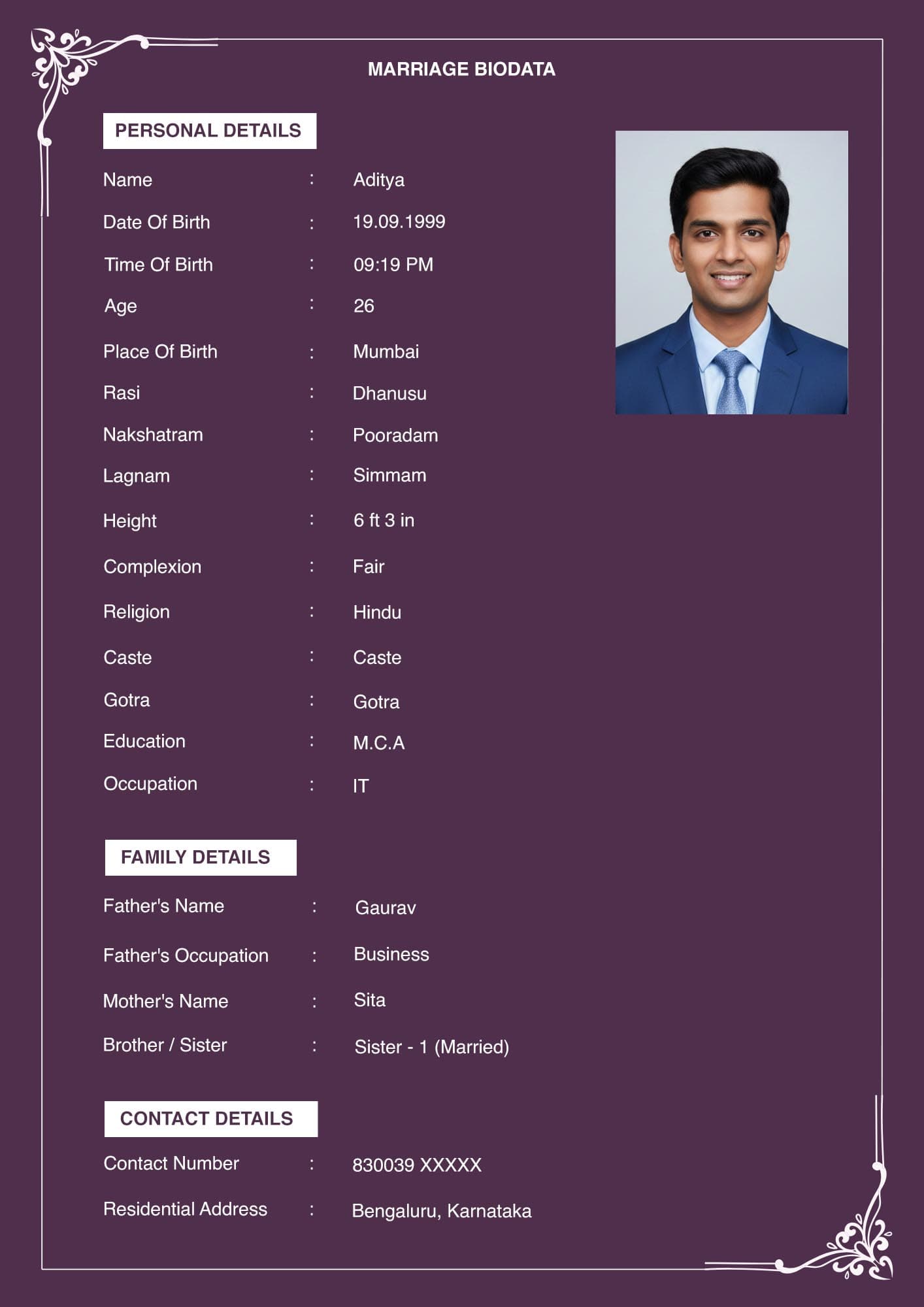
There is no official list. No authority publishes a standard, which is why every template you open has slightly different fields. What exists instead is convention. It is fairly consistent once you separate the fields families actually ask about from the ones templates add to fill space.
This is that separation.
Quick Answer A marriage biodata needs eleven fields: name, date of birth, height, education, occupation, community, father's name and occupation, mother's name and occupation, siblings, native place, and one contact number. Everything else is optional. Horoscope fields are expected in most Hindu families and do not apply in Muslim or Christian formats. Aadhaar, PAN, full address, complexion and weight should never appear.
The Eleven Fields You Cannot Skip
If a field is missing from this list, the other family will ask for it. That is the practical test of whether something is required.
| Field | Write it as | Why it is asked |
|---|---|---|
| Full name | As on your official documents | Everything later matches against this |
| Date of birth | Full date, not age | An age goes stale the moment the file is forwarded |
| Height | Feet and inches, or centimetres | Almost universally asked before a meeting |
| Education | Highest qualification, then institution | Establishes background in one line |
| Occupation | Role and sector | The single most-read line after the photo |
| Community | As your family states it | Determines whether the match is considered at all |
| Father's name and occupation | Name, then occupation or "Retired" | The family is being introduced, not only you |
| Mother's name and occupation | Name, then occupation or "Homemaker" | Leaving it out reads as carelessness |
| Siblings | Number, married or unmarried | Families want the shape of the household |
| Native place | Town or district | Used for regional and community matching |
| Contact | One person, one number, city and area | Someone has to answer the call |
Eleven fields fit comfortably on one page with a photo. That is not an accident. The format evolved around a single sheet that could be photocopied and handed around.
For the full format with worked samples, see [INTERNAL-LINK: marriage biodata format guide → pillar page].
Fields That Depend on Your Community
These are not optional in the families that expect them. They are simply not universal.
- Hindu families, North and West India. Gotra, rashi, nakshatra. Manglik status where the family follows it. Gotra is often the first question asked, because marriage within the same gotra is traditionally avoided.
- Hindu families, South India. Natchathiram or star, raasi, lagnam, and kula deivam in many Tamil and Telugu families. The field names are usually written in the regional language even when the rest of the biodata is in English.
- Muslim families. Sect, and maslak where the family considers it relevant. Horoscope fields do not apply.
- Sikh families. Some families include gotra. Amritdhari status where relevant. Personal blocks tend to be shorter.
- Christian families. Denomination and parish. No horoscope fields.
- Jain families. Sect, meaning Digambar or Shwetambar. Dietary detail is often included and is genuinely used, unlike in most other formats.
One rule covers all of these. Write the value exactly as your family or your priest states it. A guessed nakshatra is worse than an empty field, because the other family will act on what you wrote.
Genuinely Optional Fields
These help in some cases and clutter the page in others.
- Time and place of birth. Required if either family does horoscope matching. Otherwise unnecessary. If you include it, make it exact.
- Languages known. Useful when the match may cross regions. Skip it when everyone involved speaks the same language.
- Hobbies and interests. Two or three specific ones work. "Reading, music, travelling" tells the reader nothing, because it appears on almost every biodata.
- Diet. Genuinely load-bearing in Jain, many Gujarati, and many Brahmin families. Irrelevant elsewhere.
- About me. A short paragraph in your own words. Three or four honest sentences beat a list of adjectives.
- Partner expectations. Two or three real criteria. A long list reads as a demand sheet and puts families off.
What Should Never Appear
This is where most biodatas go wrong, and the damage is not obvious at the time.
Your biodata is forwarded. It moves from one WhatsApp chat to a family group, then to another family, then into a consultant's folder. You cannot recall it. Write it knowing that.
Never include your Aadhaar number, PAN, or any bank or account detail. No stage of a marriage introduction requires them. Never include your full residential address. The area and the city are what the other family actually wants to know.
Leave out your exact salary. If income needs to be indicated, a range or "as per industry standard" is the convention. A precise figure invites a negotiation you did not intend to start, and it stays attached to the document permanently.
Leave out complexion and weight. Some guides still coach people on describing skin tone politely. The better answer is not to describe it at all. The photo is already on the page.
For the full treatment, see [INTERNAL-LINK: what never to put in a biodata → spoke D2].
A Checklist You Can Work Through
Print this or keep it open while you fill the form.
Personal block
- Name matches your documents
- Full date of birth, not age
- Birth time exact, if you are including it
- Height stated honestly
- Highest qualification and institution
- Occupation as role and sector
- Community as your family states it
- Horoscope fields confirmed with family, not guessed
Family block
- Father's name and occupation
- Mother's name and occupation
- Siblings, with marital status
- Native place
- Family type, if relevant
Contact block
- One contact person named
- One phone number
- Area and city only, never the full address
- Two or three genuine expectations
Final pass
- Fits on one page
- Photo is recent and plain
- No Aadhaar, PAN, or bank detail
- No complexion, no weight, no exact salary
- Someone else has read it once
That last item catches more errors than any of the others. Ask a sibling or a cousin to read it before it goes out.
Frequently Asked Questions
What is mandatory in a marriage biodata?
Nothing is legally mandatory. In practice the eleven fields listed above are expected, and a missing one produces a follow-up question. Horoscope fields are expected in most Hindu families and do not apply in Muslim or Christian formats.
Should I write my salary in a marriage biodata?
You do not need an exact figure. Where families expect income to be indicated, a range or a standard phrase is the convention. An exact number travels with the document and narrows the conversation early.
Is an "About Me" section necessary?
No, but it helps when written honestly. Three or four sentences in your own words do more than a list of adjectives that could describe anyone.
What details should I give about siblings?
Number, whether they are married, and roughly what they do. One line. A sibling does not need their own biodata inside yours.
In Short
- Eleven fields are expected. Everything else is optional.
- Community fields are not universal. Write them exactly as your family states them, or leave them blank.
- Aadhaar, PAN, full address, complexion, weight and exact salary should never appear.
- One page, one photo, one contact person.
Next, see [INTERNAL-LINK: how a biodata differs from a resume → spoke A2] if you are still tempted to list achievements. For a layout that fits all of this on one sheet, see [INTERNAL-LINK: one-page biodata format → spoke A3].